


🔒30-Day Money Back Guarantee
Don't be the one that "should have checked"
See the exact CO level in your rig in 2 seconds — not whether the circuit has power.
Couldn't load pickup availability


How Do I Use It?
How Do I Use It?
Plug Natica into any outlet in your rig. The color screen lights up instantly and starts tracking your air in real time. No tools, no wiring, no app to download.
The built in battery charges automatically while plugged in. When shore power drops or your generator switches off, Natica keeps watching — even off grid.
For full coverage, place one in each key zone: bedroom, kitchen, living space. Once installed, they run silently in the background — you only hear them if something changes.
How many do I need?
How many do I need?
- If you choose the 2-Pack (RV Recommended): One in the sleeping area — bedroom or bunkhouse, wherever your family sleeps. One near the kitchen or living area where the stove and appliances are. That covers the two zones where CO and gas are most likely to build.
- If you choose the 3-Pack (Best Value for RV + Home): Two for the rig, one for home. CO doesn't care whether you're traveling or not — your house has the same risks from furnaces, water heaters, and attached garages.
- Single Unit: Good starting point if you have a smaller rig or want to cover just the sleeping area first.
Where not to put it: Keep it away from stove burners, air vents, and anywhere behind curtains or inside cabinets. It needs open air to read accurately.
How is this different from my factory RV detector?
How is this different from my factory RV detector?
All your factory detector has is a green light. There's no more guessing if the detector is even working or if it's a false alarm. Natica tells you in real time what's in the air.
UL 2034 states that most CO detectors can take up to 4 hours to signal a dangerous amount of CO, and by then your family has been breathing in poison for hours.
Shipping
Shipping
Processing Time
All orders are processed within 1-2 business days. You will receive a confirmation email once your order has been shipped.
Shipping Time
We deliver within 5–8 business days. Delivery times may vary depending on your location.
Tracking
Once your order is shipped, a tracking number will be provided so you can monitor its progress.
Returns & Guarantee
Returns & Guarantee
We're confident you'll love your Natica 6-in-1 Detector — but if not, you're fully protected.
You get:
- 60-Day Risk-Free Guarantee — try it, return it for any reason
- Hassle-free returns
- Full refund if you're not completely satisfied
If anything arrives damaged or stops working properly, we replace it free of charge.





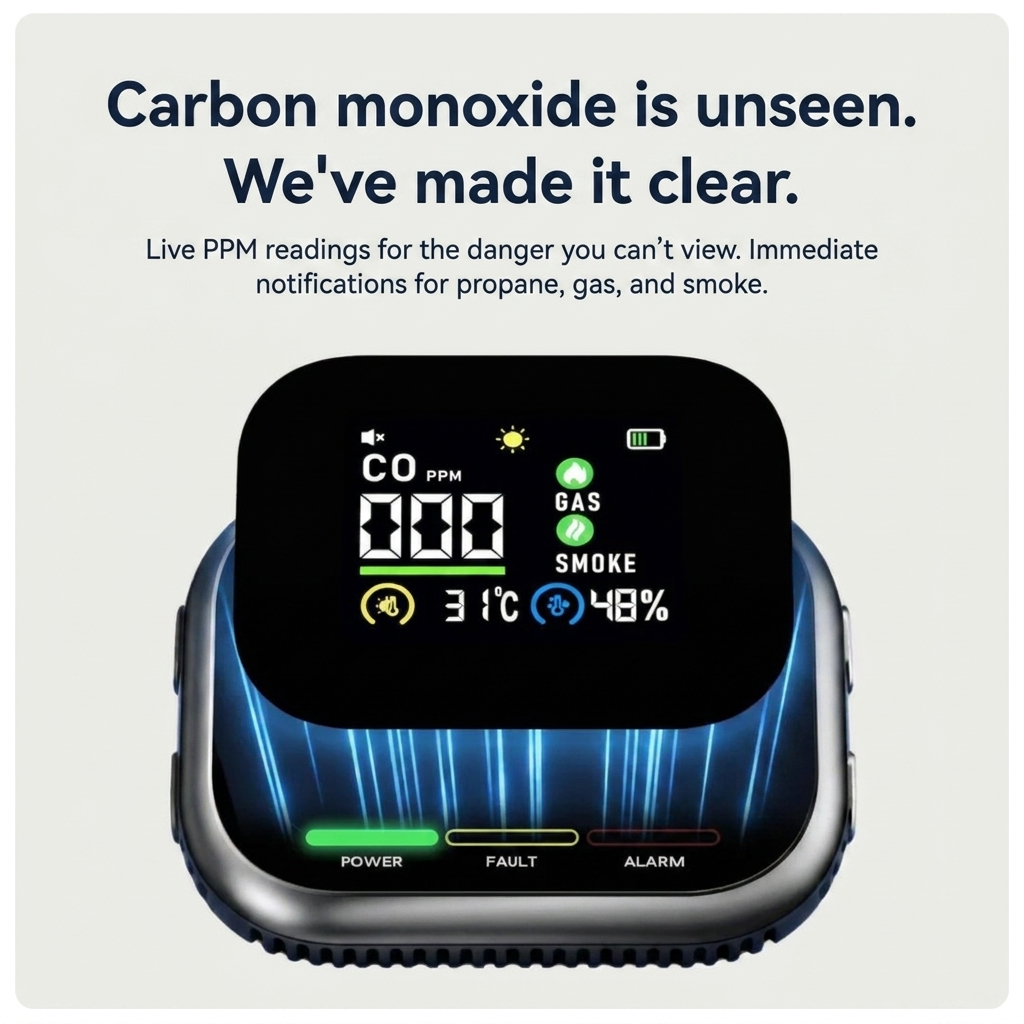

See the Number. Know You're Safe.
Carbon monoxide builds quietly. Your factory detector's green light only tells you it has power — not what's in the air. Natica shows you the actual level the moment anything changes, so your family has time to act.

What Experienced RVers Do Instead of Trusting the Factory Unit.
Experienced RVers have seen the pattern: a 'working' factory detector with a solid green light — and a family that had no idea CO was building until someone woke up with a headache. The factory unit tells you it's on. Natica tells you what's actually in the air.
Trustpilot reviews
Excellent 4.8 / 5
Frequently Asked Questions
How is this different from the detector that came with my RV?
How is this different from the detector that came with my RV?
All your factory detector has is a green light. There's no more guessing if the detector is even working or if it's a false alarm. Natica tells you in real time what's in the air.
UL 2034 states that most CO detectors can take up to 4 hours to signal a dangerous amount of CO, and by then your family has been breathing in poison for hours.
Will it work when my shore power drops or I'm boondocking?
Will it work when my shore power drops or I'm boondocking?
Yes Natica has a built in 12 hour battery that automatically charges when it's plugged in. So when you decide to disconnect Natica is still protecting you.
How many should I get and where do I put them?
How many should I get and where do I put them?
- If you choose the 2-Pack (RV Recommended): One in the sleeping area — bedroom or bunkhouse, wherever your family sleeps. One near the kitchen or living area where the stove and appliances are. That covers the two zones where CO and gas are most likely to build.
- If you choose the 3-Pack (Best Value for RV + Home): Two for the rig, one for home. CO doesn't care whether you're traveling or not — your house has the same risks from furnaces, water heaters, and attached garages.
- Single Unit: Good starting point if you have a smaller rig or want to cover just the sleeping area first.
Where not to put it: Keep it away from stove burners, air vents, and anywhere behind curtains or inside cabinets. It needs open air to read accurately.
Will it false alarm from cooking, propane fridge, or aerosol sprays?
Will it false alarm from cooking, propane fridge, or aerosol sprays?
Natica uses electrochemical and photoelectric sensors with selective gas detection — much less prone to false alarms than older RV detectors. The CO sensor specifically targets carbon monoxide and won't trigger from normal cooking steam, humidity, or aerosol sprays.
Avoid placing it directly across from a stove burner if you cook frequently with high heat.
Does this work for my home too?
Does this work for my home too?
Yes. Carbon monoxide is just as dangerous at home as on the road, and home detectors expire too, often without you knowing. Natica plugs into any standard outlet, so it protects your house just like your rig, especially near where you sleep.
How do I know it's actually working?
How do I know it's actually working?
Most factory detectors only let you press a test button that checks the speaker — not the sensor. So you press the button, hear a beep, and assume it's working. The sensor inside could be completely dead and the button would still beep.
With Natica, you don't have to guess. The screen shows you real-time numbers. CO at 0 PPM. Temperature. Humidity. The numbers themselves are the proof. If they're changing in response to your environment, the sensors are working.
Will it survive RV vibration and travel?
Will it survive RV vibration and travel?
Yes. Natica is built with reinforced housing and solid-state sensors designed for mobile environments. It's been tested for stability through road vibration, temperature shifts, and humidity changes.
For long-term storage or rough roads, you can unplug it and store it in a cabinet — it will retain its calibration when you plug it back in.